

The Construction Industry Culture Taskforce (CICT) is a collaboration between the Australian Constructors Association, the New South Wales and Victorian Governments and leading academics. Since 2018 the CICT have been working to develop a Culture Standard which aims to drive more flexible work arrangements and reduce excessive work hours and six-day work weeks, which are prevalent in the industry.
The Culture Standard has been piloted on five large government infrastructure projects, to assess its effectiveness.
Frontier Economics assisted the CICT to evaluate whether, on the pilot projects, the implementation of the Culture Standard:
- affected productivity and
- led to other benefits or costs for workers, the industry and society more broadly.
The final Culture in Construction Report can be found here. Below, we share our contributions to the work, and our findings.
What is the Culture Standard?
The Culture Standard is intended to be incorporated into public sector infrastructure procurement processes. It requires signatory organisations to program their project to, amongst other things:
- enable all workers to work 50 hours or less per week;
- to either operate the site from Monday to Friday or ensure all workers are working a five day per week program; and
- report on compliance with the planned schedule during delivery.
On some projects (particularly transport relate projects) there was a concern that meeting the Culture Standard may be unviable. Because of the need to maintain the operation of critical infrastructure during construction and where work to be conducted is necessary to protect public safety (e.g. crane installations).
Therefore, the Culture Standard allows for flexibility in its implementation. Fundamentally it aims to focus management attention on addressing the industry’s culture of long working hours and lack of diversity in order to improve work wellbeing.
The construction sector’s culture could be weighing it down

Source: p7, CICT, ‘A Culture Standard for the Construction Industry – Consultation Paper’
How we measured the impacts of the Culture Standard
To measure whether the Culture Standard affected productivity and led to other benefits or costs for workers, the industry and society more broadly, we met with pilot project representatives to collect and analyse data. This included data on:
- work hours,
- workplace incidents and accidents,
- absenteeism, and
- turnover.
This was to understand how outcomes on the pilots might have differed by virtue of implementing the Culture Standard we developed a baseline or counterfactual estimates against which pilot project outcomes could be compared.
An improvement in productivity within a sector only leads to a benefit to society if it does not come at the expense of other things such as worker wellbeing or drive-up costs in other sectors of the economy i.e. for the health care system.
Hence, we explored, and where possible, monetised the costs and benefits for society that may arise from the broader implementation of the Culture Standard to inform government decision making.
Summary of findings
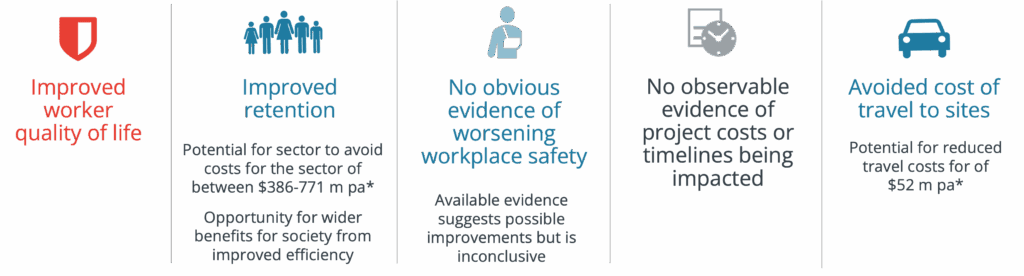
Source: Frontier Economics
Positive results for construction projects and society
In implementing the Culture Standard, most pilot projects moved to a compressed 5-day work week (with a relatively small reduction in average hours).
Importantly, a comprehensive survey of workers on the pilots showed the majority of workers preferred working a 5-day week. All things being equal this preference suggests the scheduling arrangements adopted on the pilots improved worker’s quality of life. This represents a real and substantive net benefit to society.
That is, unless this change has driven other wider costs for society. Our analysis suggests there were no observable negative impacts for construction sector productivity or society more broadly.
There was no observable or definitive evidence to suggest project costs and timelines were impacted one way or the other.
Given, for the most part, the Culture Standard resulted in hours of work being redistributed across the week rather than reduced substantially there is no clear rational for project costs and timelines being affected. The impact of the Culture Standard on worker utilisation and task efficiency were difficult to observe. However, anecdotes from pilot participants suggested this differed by task. In some cases, it reduced the need for mobilisation and pack up, and in others it made the work more susceptible to delays from rain etc.
However, anecdotally most pilot participants suggested that the change to a five-day week schedule was unlikely to have led to significant program extensions. This is because even if the provisions impacted worker productivity or utilisation it was often possible to plan the program around any challenges identified. It is expected that over time the ability of contractors to do this would improve.
Available data suggests there was no obvious worsening of workplace safety
While not conclusive, data from the pilot projects suggested that workplace health and safety was not affected by the scheduling changes implemented on the pilots. Average total recorded injury frequency rates were on average lower on pilot projects when compared to both industry averages and the average levels for the pilot organisations as a whole, however, there was variation across pilots.
Project pilots had on average notably lower levels of turnover
Turnover in staff employed on the pilot project were on average 4.4% lower when compared to average levels of turnover across the pilot organisations wider workforce.
This suggest staff employed on projects complying with the Culture Standard are less likely to leave the organisation. Turnover creates real cost in terms of onboarding and upskilling, and the Culture Standard seems to help reduce these costs.
If the Culture Standard was rolled out across the board and drove an equivalent reduction in turnover across the Construction industry in NSW and Victoria we estimated that this would generate:
Avoided costs of between $386-771 million pa.*
It is also expected that, in the long run, the Culture Standard may encourage the retention of experienced and trained workers (female workers in particular). This will drive additional efficiencies. In addition, enhanced retention and the encouragement of more workers into the sector could also help address worker shortages in the sector that may be constraining output and driving cost escalation.
*Estimates represent the avoided costs to the NSW and Victorian construction sector (FY$25) based on the assumption that broad rollout of the Culture Standard in these states results in reductions in turnovers equivalent to those observed on the pilot projects.
Other impacts for society
- Findings from the pilot surveys suggest mental health and wellbeing of workers improved.
- With fewer days worked pilot project workers would also likely have experienced reduced travel costs. If the Culture Standard was rolled out across the board in NSW and Victoria this would equate to an aggregate impact of close to $52m per annum.
- It is possible that if the Culture Standard lead to project program extensions, then this could impose disruption costs on the wider community, particularly, for road and transport projects. However, this would vary by project type.