Cost-benefit analysis (CBA) is a systematic approach used to assess the value to the community of investments, policy and regulatory changes. It involves comparing the social, cultural, environmental and economic costs and benefits (monetary and non-monetary) of an investment, decision or regulatory change. Its goal is to determine value to the community expressing outcomes on a net present value (NPV) basis.
Real options analysis (ROA) builds on CBA to assess value under uncertainty by incorporating the value of flexibility and ‘optionality’ in decision-making. Originating as a valuation tool in the financial sector and later extended to broader decision-making across the economy, it enables decision-makers to understand the value of multiple possible pathways when presented with uncertainties and irreversible (or costly-to-reverse) decision “triggers”– ultimately expressing the value of these options on an expected net present value (ENPV) basis.
We recognise that no two projects, or questions are alike
With decades of experience in economic analysis, we work alongside sector experts like engineers, planners, hydrologists, ecologists, climate scientists and engagement specialists to help decision makers answer questions like:
- Does desalination, water recycling or water conservation deliver the greatest value for our community, given uncertainties around climate risks?
- What is the value of proactive versus reactive approaches to managing the risk of coastal inundation?
- Should we aim to eradicate or control a feral pest?
- How can we value the multi-sectoral outcomes from investment in waste to energy & circular economy initiatives?
- How can we justify investment in enhancing the resilience of the energy sector to storm events or other supply disruptions?
- What’s the community value of increased tree canopy and open space in managing urban heat?
- Should we strengthen regulation around safety on roads?
We’ve answered these questions and more for utilities, regulators, local, state and federal government private and public sectors across industries such as the urban and rural water, transport, urban planning and social infrastructure, energy and renewables, biodiversity, and telecommunications.
These analyses are often integral components of business cases to support agency or business decision-making. In many cases they form part of the evidence-base presented to governments, regulators and/or other stakeholders to demonstrate the value of ‘build and/or non build’ solutions.
For example, many utilities must undertake CBAs (such as in regulatory investment tests) to support investments in their pricing proposals to economic regulators. Similarly, government agencies recognise that it is best practice to undertake CBA for Regulatory Impact Statements pertaining to significant policy changes and interventions.
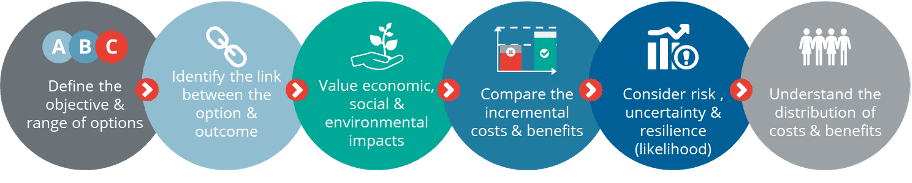
Our holistic and transparent approach to economic appraisal (including CBA or ROA) involves:
- Considering the broad range of build and non-build measures to address a problem or achieve an objective
- Identifying the causal link between the proposed measure and changes in economic, social and environmental outcomes
- Evaluating economic, cultural, social and environmental impacts, both monetary and non-monetary, from investments, regulatory changes and public policy decisions.
- Risk and uncertainty analysis, including sensitivity and scenario analysis, Monte Carlo analysis, adaptive pathways and real options analysis.
- Distributional analysis to provide further information on how different community groups are impacted from the investments, regulatory changes and public policy decisions.
Figure 1: Six broad steps to economic appraisal

Supporting government in customised CBA guidelines
Applying economic appraisal principles in these steps in different contexts is not always straightforward.
We’ve also helped local, state and federal agencies in developing sector specific cost-benefit analysis guidelines to help users build the necessary capabilities and processes required to evaluate the broad range of economic, social and environmental impacts, consistent with best practice, and general State and Commonwealth guidance.
This includes developing guidelines to:
Understanding the value of resilience and flexibility, given uncertainty
Risks and uncertainties such as population growth, climate change, drought and flood, ageing infrastructure, and changing community expectations present significant challenges in delivering blue, green and grey infrastructure in Australia, and beyond.
However, the likelihood and consequence of many of these risks are uncertain, which can make planning challenging and increase the potential for investment ‘regret’. This is because standard techniques used to appraise commercial and government decisions often ignore the value of flexibility to adapt strategies as circumstances change. Mis-valuation of this kind can result in suboptimal decisions being chosen. This problem can be particularly acute for major infrastructure projects and/or urban planning decisions, which typically involve large and irreversible decisions in an environment of significant uncertainty.
We leverage a range of risk and uncertainty tools in our models for economic appraisal to ensure we can support you by considering a project’s specific characteristics and risks. These include:
- Standard sensitivity and scenario analysis as part of CBA;
- Quantitative adaptive pathways analysis; and
- Real options analysis.
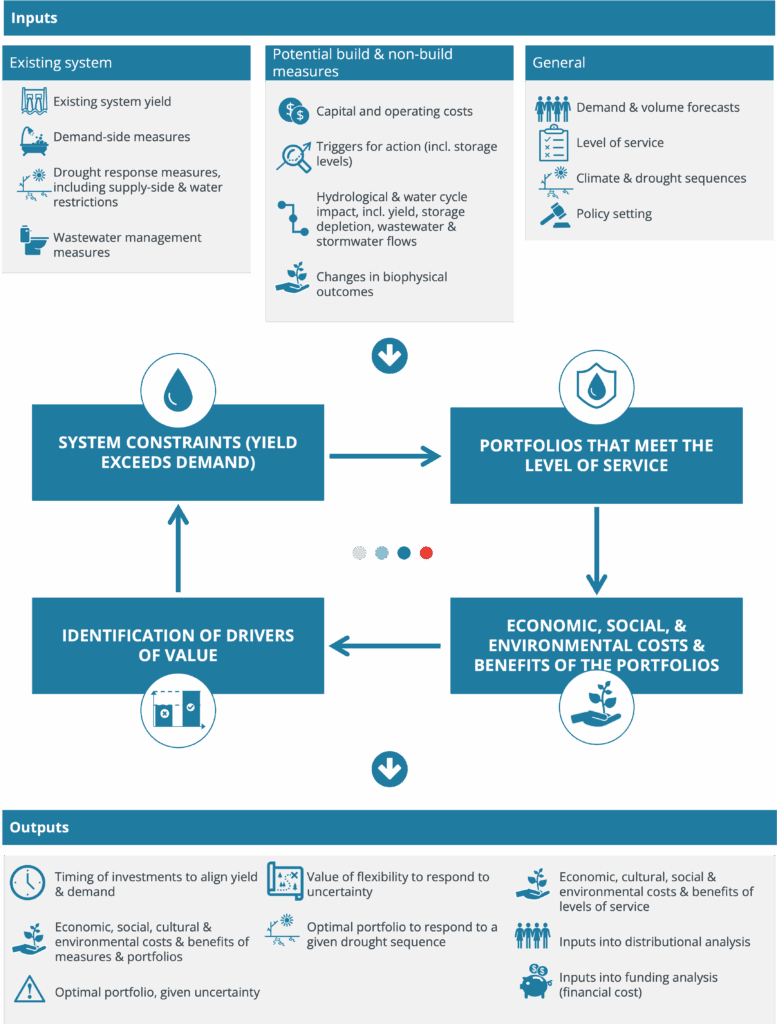
For example, we worked with Hunter Water to develop the Lower Hunter Water Security Plan, which used our bespoke hydro-economic model to evaluate the economic, social and environmental costs and benefits portfolios of water supply and demand measures under a range of climate and other uncertainties. This model incorporated standard sensitivity and scenario analysis as well as real options analysis.
Learn more about our hydro-economic model here:
Given the increasingly interrelated nature of our water cycle, it’s no longer enough to separately assess our investments to manage long-term water security, short-term drought and wastewater and stormwater volumes.
Combining hydrological and economic analysis, our latest water model assesses the costs and benefits of alternative drought sequences to identify which supply or demand measure, or portfolio of measures, delivers the greatest value to the community, given uncertainty.
Our model helps decision makers answer questions like these, and more:
- Does desalination, water recycling, purified recycled water or water conservation deliver the greatest value for our community?
- What value can water restrictions provide in managing drought, given uncertainty around the severity of drought?
- What level of water security should we be delivering to our customers?
- How should prices be set to recover these costs?
With 20+ years of experience in evaluating the economic, cultural, social and environmental costs and benefits of water security measures, under uncertainty, our Hydro-economic CBA model provides advanced risk and uncertainty analysis using real options analysis.
The model combines the flexibility to model multiple drought sequences at once – to answer what should we do given we don’t know whether we will go into extreme drought and in-depth analysis of a single drought sequence to answer – if we were in this drought sequence, what should we do?