Fluctuating environmental conditions, with droughts and floods impacting both regional and urban areas, highlight the increasing intricacies of managing water resources for a resilient future. Our economic analysis and modelling capabilities address the complexities of the water industry and deliver innovative solutions to businesses, policymakers, and regulators.
The economics of protecting our water resources for resilient futures
The context of water has shifted - from a utility supply, and input to production, to a valuable natural resource with economic, social, environmental and cultural importance.
But across urban and rural settings, concerns around water resources are multi-faceted. Covering climate variability and change, growing populations, a growing appreciation of the health of our rivers and wetlands, and the affordability of water services.
Our water resources must be managed in the context of a drying climate, and where alternative or manufactured – albeit more costly - sources can be drawn upon.
Shaping the future of water: specialist economic advisory for policy, regulation and market design
At Frontier Economics, we havea track record in shaping water policies and regulatory frameworks globally, that honour the essential environmental and societal values connected to our water resource.We'reat the forefront of market design and operations; on urban and rural water reform, and the interplay between climate and water policies, both nationally and internationally, for both the public and private sectors.
One of our key priorities is to apply economicsto understand the value of water, beyond the financial costs. Whether this is for price setting, business cases and cost-benefit-analysis,funding and distribution analysis,or to understand future investments and planning.
Partnering with hydrologists, engineers, environmental scientists and many others, we ensure our clients get comprehensive solutions including:
Industry reform and institutional design: Crafting strategies to reshape the industry for optimum functionality,resilience,andsupporting the market response for private sector firms.
Pricing and regulation:We advise regulated businesses, but also the regulators, on a range of issues includingdeveloping balanced and effective pricing and regulatory frameworks.
Competition and third-party access: Advancing competition in the provision of water and wastewater services and facilitating effective third-party access.
Market design, operation and trading: Integrating best practices and in-depth knowledge of the water sector to establish efficient water markets. Leveraging our extensive knowledge and network to design and refine effective water trading markets.
Investment and resource planning: Applying economic frameworks to assess long-term planning issues and developing business cases for public-sector project funding.
Water supply & investment models:We offer powerful tools for optimising long-term augmentation plans and operational decisions in water systems including supply / demand models, system-based Long Running Margin Costs (LRMCs), cost benefit analysis and real option analysis modelling.
Learn more about our water-related economic tools and modelling:
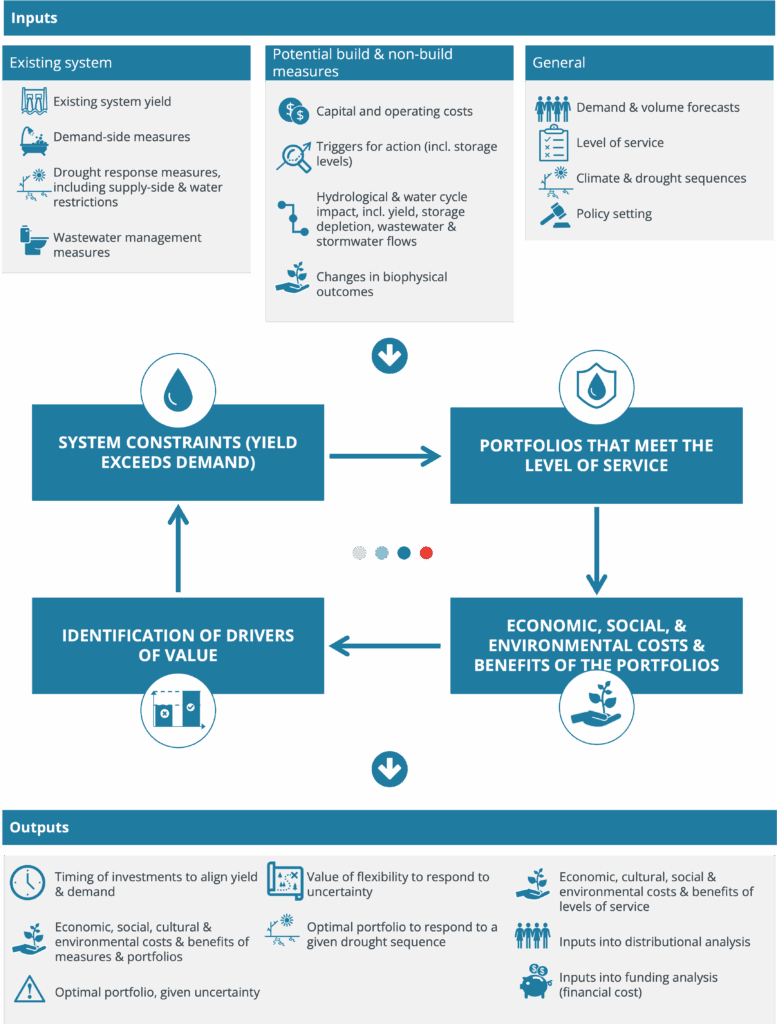
Given the increasingly interrelated nature of our water cycle, it’s no longer enough to separately assess our investments to manage long-term water security, short-term drought and wastewater and stormwater volumes.
Combining hydrological and economic analysis, our latest water model assesses the costs and benefits of alternative drought sequences to identify which supply or demand measure, or portfolio of measures, delivers the greatest value to the community, given uncertainty.
Our model helps decision makers answer questions like these, and more:
Does desalination, water recycling, purified recycled water or water conservation deliver the greatest value for our community?
What value can water restrictions provide in managing drought, given uncertainty around the severity of drought?
What level of water security should we be delivering to our customers?
How should prices be set to recover these costs?
With 20+ years of experience in evaluating the economic, cultural, social and environmental costs and benefits of water security measures, under uncertainty, our Hydroeconomic CBA model provides advanced risk and uncertainty analysis using real options analysis.
The model combines the flexibility to model multiple drought sequences at once – to answer what should we do given we don’t know whether we will go into extreme drought and in-depth analysis of a single drought sequence to answer – if we were in this drought sequence, what should we do?
Using economic analysis and data to inform policy and regulation for more than 20 years, policymakers and industry leaders have trusted us to find data-backed solutions, with projects such as:
Public Sector
Private Sector
Determining the social and economic impacts of the the Basin Plan water recovery in Victoria.
Advising on water price determinations - submissions to economic regulators.
Reviewing the economic and regulatory barriers to cost-effective water recycling.
Analysing the role of water in facilitating the liveability of cities for the Water Services Association of Australia.
Assessment of the benefits from collective action to reduce salinity levels in the Murray River
As community, business and governments prioritise sustainability, the tools of environmental economics play a pivotal role in guiding policy decisions, fostering responsible business practices and ensuring that economic activities align with long-term ecological well-being.
The challenges facing us in urban growth and development are varied. Poor decisions can have far-reaching consequences. It is critical to get policy development and investment in these areas right.
Most firms face regulation of some form, while some industries are subject to explicit economic regulation. Regulated industries include ‘utility’ industries such as energy, water and telecommunications and media as well as the transport, financial services and natural resources (forestry, fisheries) sectors.
Sometimes clients face specific sector issues or have particular economic and financial modelling problems. Our model development expertise allows us to build bespoke and purposeful models which provide our clients with powerful, robust insights and analysis.
Independent and unbiased public policy advice, underpinned by economic data and decades of industry experience, ensures governments and the private sector make decisions and manage resources optimally and appropriately, while balancing conflicting objectives.
In the complex world of economics and business decision-making, it's crucial to make informed choices. The consequences of a poorly thought-out decisions can be detrimental to organisations and the societies effected by their decisions. This is where cost benefit analysis consulting comes in.