Back to insights
Case study | 14 April 2024

Regulation of aviation services charges | Malaysian Aviation Commission

View our case study on how we helped the Malaysian Aviation Commission develop a transitional regulatory framework and aviation services charges.

airplane

What was the challenge?

The Malaysian Aviation Commission is responsible for regulating aviation services charges levied on passengers and airlines at airports in Malaysia.

The Commission was looking to transition to a cost-based regulatory framework. One that would result in aviation service charges being set to allow operators, such as Malaysia Airports Holdings Berhad (MAHB), to recover their prudent and efficient costs, including a reasonable return on invested capital.

However, given the historically low levels of charges, and the growing need for large strategic investments at airports, this transition was likely to result in a substantial increase in the tariffs paid by airlines and passengers. Additionally, at the time the Commission was reviewing the regulatory framework, the aviation sector was still recovering from the unprecedented downturn in revenue and uncertainty caused by the COVID-19 pandemic.

As such, any change to the regulatory framework needed to balance the objectives of:

  • promoting efficiency by moving to a cost-based approach to setting tariffs; and
  • ensuring continuing growth in, and competitiveness of, the Malaysian aviation sector.

We were engaged by the Commission to develop a transitional regulatory framework and aviation services charges for the period 2024-27, which addressed the objectives and challenges above.

How did we complete the economic modelling and analysis?

To inform our analysis, we:

a) undertook extensive consultation with stakeholders including airport operators, airlines, investors and financial institutions, government representatives, international aviation bodies and consumer associations;

b) undertook detailed revenue and tariff modelling to set the tariffs that an operator would need to charge to recover its efficient costs, and raise capital to finance efficient investment;

c) developed a ‘financeability test’ to assess whether an efficient operator would be able to meet its debt obligations under the regulated tariffs; and

d) analysed the price elasticity of air travel for different types of passengers.

Our transitional regulatory framework and analysis also addressed the uncertain trajectory for returning to pre-COVID levels of traffic. We did this by creating innovative risk sharing mechanisms, through extensive scenario and sensitivity analysis, and through our discussions with industry stakeholders.

What were the results?

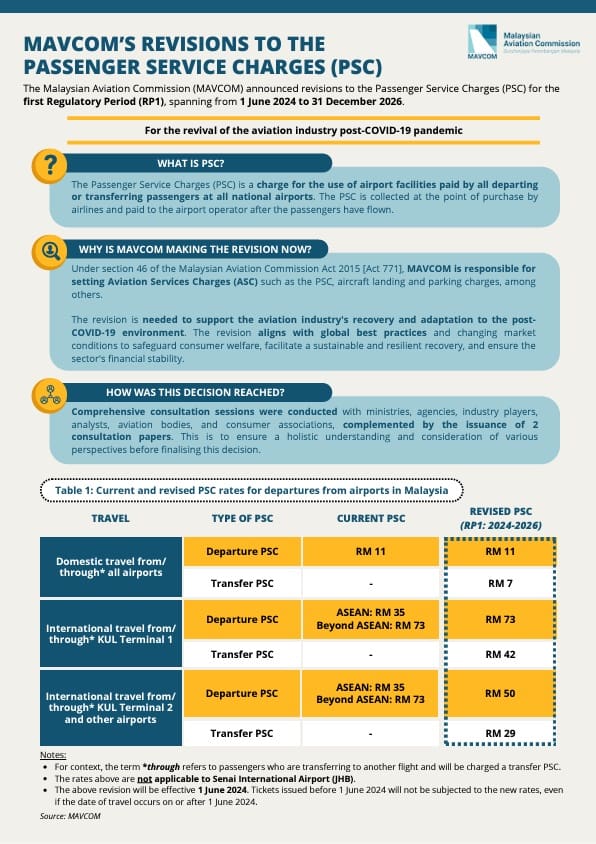
We developed a revised set of aviation service charges for the first regulatory period that would aid in the transition to a cost reflective set of charges, while supporting the recovery of airlines operating in Malaysia after COVID-19, and the financeability of airport operators. The key changes included:

  • Introducing a single unified international passenger service charge (PSC) to reflect that both ASEAN and non-ASEAN passengers utilise the same facilities and services at an airport, and so are likely to impose similar costs on airport operators.
  • Differentiating international PSC by airport terminals.
  • Introducing a new PSC that applies to all passengers transferring at an airport in Malaysia; on the basis that they should contribute to the cost of the infrastructure that they use at the airport at which they transfer.
  • Moderated increases in tariff levels that appropriately balance the competing objectives of moving closer towards a cost-based approach to setting tariffs, while minimising the transitional impact that tariff increases may have on passenger traffic and the competitiveness of the Malaysian aviation sector during the recovery from COVID-19.

The proposed tariffs are expected to be below the cost reflective level that might be determined under a cost-based framework with normalised traffic levels.

Our financeability analysis shows that applying these tariffs is unlikely to prevent an efficient operator from servicing its debt obligations, or investing in efficient airport infrastructure.

To address the issue of cost recovery, we proposed the introduction of a loss capitalisation mechanism that would allow operators to recoup in future regulatory periods any allowed revenues that could not be recovered in the current period, due to traffic volumes that remain depressed following the COVID-19 pandemic.

DOWNLOAD THE FACTSHEET

DOWNLOAD THE DECISION PAPER

Related reading

All insights

What can we help you with?

Ask us

Get our latest insights

Sign up