
Case study | 23 November 2025

Byron Bay short-term rental accommodation cap evaluation | Airbnb

View our case study on how we evaluated the effectiveness of the Byron Bay short-term rental accommodation cap for Airbnb.

What was the challenge?

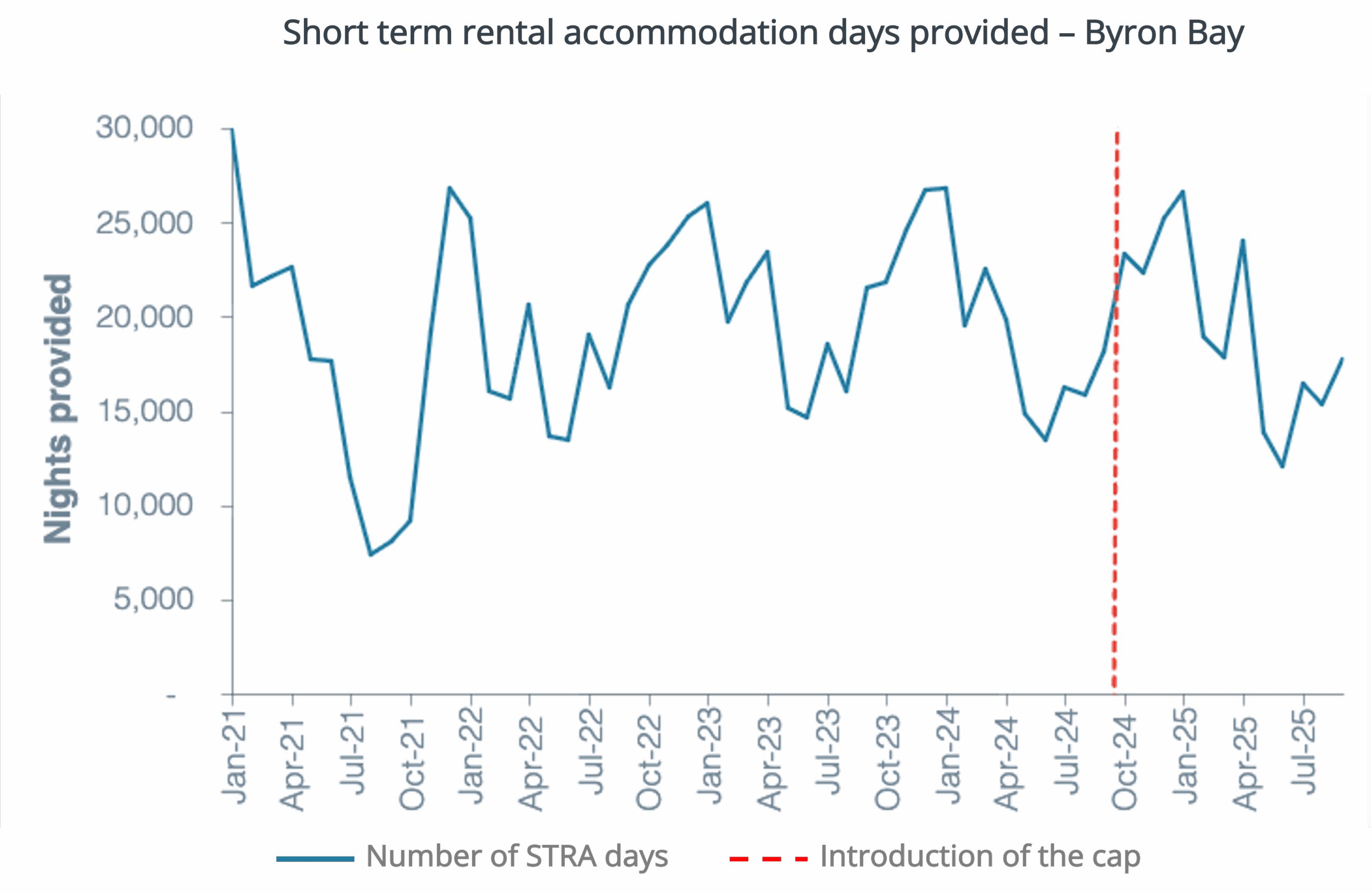
In September 2024, Byron Shire introduced a 60-day cap for non-hosted short term rental accommodation (STRA) provided in a 12-month period, with some areas exempt from the cap. This cap is in addition to other STRA regulation at the statewide level and replaces a previous 180-day cap introduced in January 2022.

The cap was intended to be a balanced response to Byron Shire’s unique housing challenges, with non-hosted STRA in Byron Shire considered as contributing to the lack of affordable and available long-term rental housing. By limiting the capacity of property owners to earn income through providing STRA, the cap sought to incentivise property owners to reallocate housing from STRA to the long-term rental accommodation (LTRA) market.

In this context, we were engaged by Airbnb to perform an independent evaluation of the 60-day cap, examining the impact on the STRA market and LTRA market. This evaluation was to provide a view, 12 months post intervention, as to whether the intervention was achieving the stated goals.

▲7%
increase in weekly rents
less homes available to rent

How did we complete the economic modelling and analysis?

Using detailed econometric analysis, we estimated the impact of the intervention on key outcomes of the long-term and short-term rental markets.

This included difference-in-differences analysis, allowing us to isolate the impact of the intervention, controlling for other changes.

The analysis utilised detailed independently sourced data on short-term rental activity at the property level, as well as public data on long-term rental activity. We use data provided by AirDNA on STRA activity, and data provided by NSW Fair Trading on rental activity.

Our quantitative analysis was supported by qualitative analysis by SEC Newgate, conducting interviews with business owners in Byron Shire to provide context and sense check our empirical results.

What were the results?

The qualitative analysis found that almost all businesses interviewed commented on the lack of affordable housing and felt that, if anything, the situation was worsening, with significant natural disasters (floods, fires, cyclones) reducing housing. Staffing challenges remained and none of the businesses interviewed reported any improvement in the availability of casual staff.

We do not observe any significant impact on the STRA market

Quantitatively, while we observed some movement in the number of properties leaving the STRA market, the properties that left were overwhelmingly those that previously sold very few nights of STRA, i.e. they would not have been directly impacted by a 60-day cap. Instead, we see very little impact on STRA activity as measured by the number of nights provided (shown in figure above).

We do not observe any significant impact on the LTRA market

We observe no improvement in the LTRA market attributable to the intervention. The number of rentals (measured by rental bonds held) actually decreased from September 2024, reversing the pre-intervention trend. We note that similar reductions occurred elsewhere, so that we cannot attribute the decline to the intervention.

We similarly observe an increase in weekly rents: the average weekly rent for a house increased from $1,112 to $1,193, or 7%, comparing new leases in the September quarter of 2025 vs the September quarter of 2024. Controlling for property type and bedrooms, in the figure to the right, weekly rents are estimated to be 5% higher in the September quarter of 2025 compared to the September quarter of 2024, in line with trends.

Our analysis of the LTRA market after the implementation of the 60-day rental cap in the Byron Shire finds that, one year after implementation, there is no evidence that the 60-day cap has been effective in achieving its stated goal of increasing long-term rental availability and affordability.

Download Full Report

Download Technical Annex

Related reading

All insights

What can we help you with?

Ask us

Get our latest insights

Sign up