
Case study | 12 October 2025

Valuation of Structured Notes

View our case study on how we helped a financial advisory and restructuring firm value a number of exotic structured notes.

What was the challenge?

When a large investment fund was placed into receivership, the appointed restructuring firm needed to determine the fair market value of the fund’s remaining investment assets. The portfolio included several exotic structured notes, complex hybrid securities that are not publicly traded and have no observable market prices. Frontier Economics was engaged to independently value these assets as part of the receivership process.

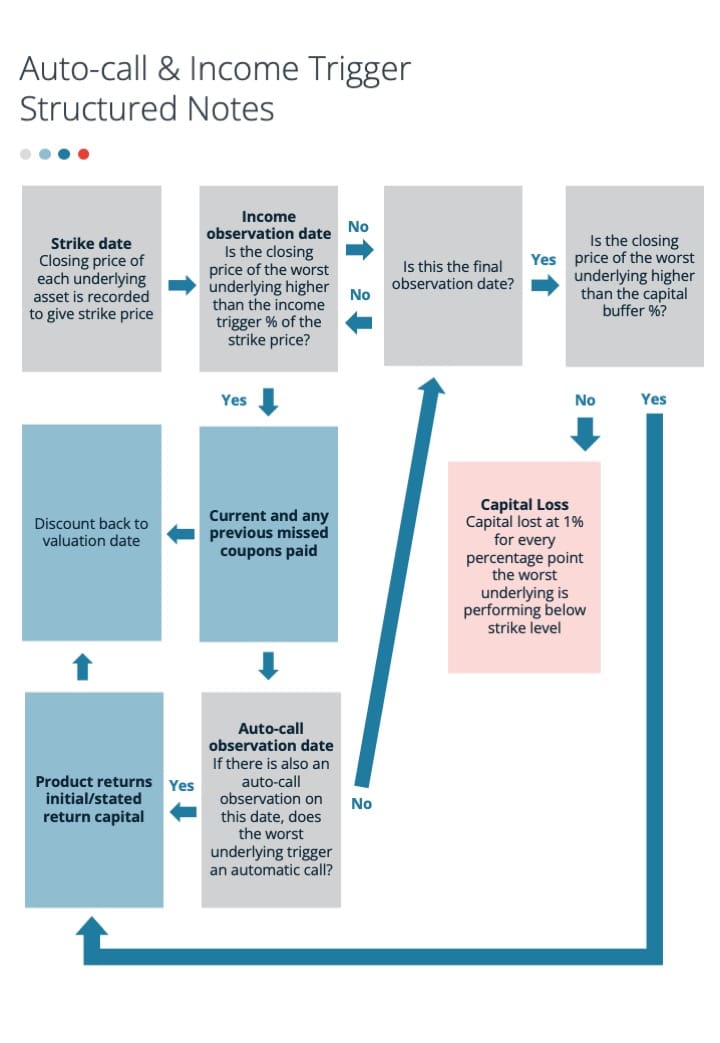
The securities to be valued were variants of ‘auto-call structured notes.’ While each note has its own particular terms, they share a number of common features.

  • Each note generates a payoff that depends on the evolution of one or more underlying indexes (or sometimes individual stocks).
  • Each note has a specific life with a set number of ‘observation dates.’ If all underlying indexes are above their starting levels on that date the note is auto-called and the owner receives a specified payment, and the note terminates.
  • The amount of the auto-call payment varies across notes. Most commonly, the amount is set equal to the initial investment plus an additional amount that depends on the time elapsed since the note was issued.

If the note reaches the end of its specified life without being auto-called, there are generally two possibilities. Both possibilities depend on the level of the worst-performing underlying index at the end of the note’s specified life:

  • If the worst -performing index is above the ‘capital protection level’, the note pays out 100% of the initial investment; and
  • If the worst-performing index is below the capital protection level, the note pays out that proportion of the initial investment.

55
Structured Notes valued
6
different types of notes
1000+
simulations for each underlying index or stock

How did we complete the economic modelling and analysis?

The different types of structured notes requiring valuation included:

  • Simple Auto-Calls: Require modelling whether early redemption will occur across multiple dates, based on the paths of underlying indexes.
  • Low Hurdle Auto-Calls: Use lower triggers, making early redemption more likely and the valuation more sensitive to market fluctuations.
  • Income Trigger Auto-Calls: Add complexity by paying coupons only if certain conditions hold at observation dates, requiring detailed scenario modelling.
  • Zero-Coupon Pre-Set Notes: Fixed amount paid at maturity, but embedded features require careful valuation of timing and interest rate impacts.
  • Zero-Coupon Upside Participation Notes: Payoff at the end of the term is equal to a pre-determined payoff function. Limits downside risk by guaranteeing a redemption value at least equal to a set percentage of the initial investment.
  • Zero-Coupon Issuer Callable Notes: Allow the issuer to redeem early, so the valuation must anticipate that under different market conditions.

We first determined whether each note had been auto-called prior to our valuation date. If the security had paid out, we reported the date and amount of that payout. This was done by obtaining historical stock return data for every day between the security’s issuance and valuation date. Using that data we checked each observation date for that security to determine whether the auto-call conditions had been satisfied.

For any structured note that had not been auto-called prior to the valuation date, we performed a first-principles Monte Carlo valuation of the security as at the valuation date. Monte Carlo simulation uses repeated random sampling to estimate outcomes for complex problems that cannot be solved analytically. The fair value of each note was then computed by:

  • Simulating 1,000 potential future paths of each of the underlying indexes – from the valuation date through to maturity of the security. The simulations are performed in the standard manner as correlated Brownian diffusion processes;
  • Determining the payoff on the note for each of the 1,000 simulated paths. The payoff for a particular simulation can be from an auto-call on a future observation date or a final payoff on the maturity date;
  • Discounting each of the future payoffs back to present value as at the valuation date; and
  • Taking the average of the 1,000 present value payoffs.

Some more complex notes also pay coupons under certain conditions. For each of the observation dates, we tested whether the conditions have been satisfied and discounted any coupons to present value.

What were the results?

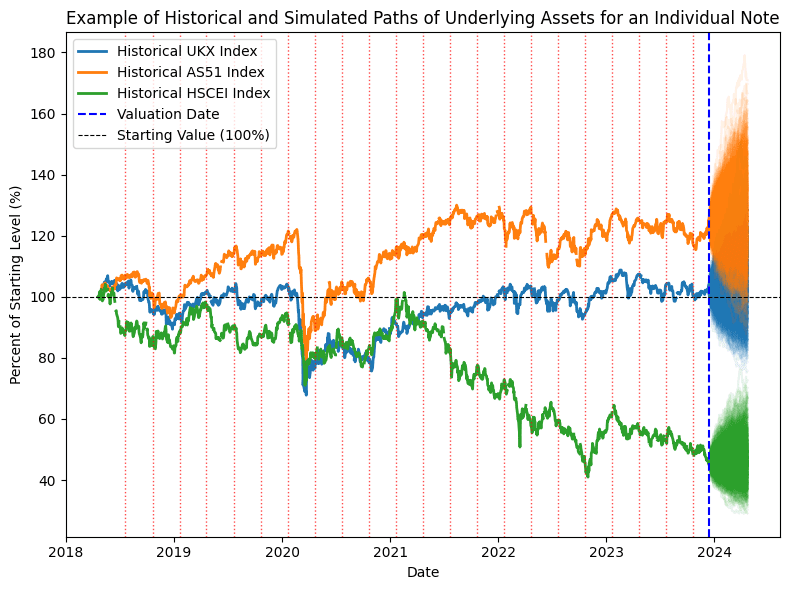
To the right is an example of the Monte Carlo simulation used to value a note that has not been auto-called by the valuation date. It is evident that this note has not been auto-called on any of the observation dates – such a call only occurs when all three underlying indexes are above their starting level. The valuation date is identified by the blue dashed line. The forward-looking simulations from that point show that the HSCEI Index (green line) is unlikely to recover to even 70% of its starting level. As a result, a full 100% capital return is unlikely. Thus, the final payoff is expected to equal the proportion of the HSCEI Index’s ending level relative to its initial level.

Our final report to the client presented the valuation for all 55 structured notes and other assets. It also set out a detailed methodology including worked examples for each type of note.

Our methodology, while complex, had strong theoretical underpinnings and was presented in a transparent manner enabling our calculations to be verified and replicated.

For more insights into our approach, and other examples of the valuation of complex derivatives, reach out to our team. A broader description of our financial expertise can be found here.

Related reading

All insights

What can we help you with?

Ask us

Get our latest insights

Sign up