Case study | 13 August 2026

WWF-Australia | Quantifying the Financial Risk of Native Forest Wood Supply Agreements

What was the challenge?

The Forestry Corporation of New South Wales (FCNSW) supplies native forest logs to sawmills and processors under long-term contracts known as Wood Supply Agreements (WSAs). These agreements commit FCNSW to fixed volumes of North Coast native forest timber until 2028, when the NSW Government will need to decide whether to extend them.

The difficulty is that WSAs commit FCNSW to fixed allocation volumes, while the harvestable resource is shrinking. Bushfires, historic over-harvesting, expanding conservation areas such as the Great Koala National Park, and a changed federal regulatory regime from July 2027 are all reducing harvestable volumes. Where FCNSW cannot deliver, the Government becomes liable to buy back the shortfall.

That is not a hypothetical: the State paid $8.55 million to buy back allocation in 2014, and negotiated further compensation in 2025 following the moratorium on logging to establish the Great Koala National Park.

WWF–Australia asked us to quantify this risk exposure. Specifically, we were asked to estimate the financial exposure the NSW Government could face if North Coast WSAs are extended beyond 2028 and those supply commitments cannot be met.

193,000m³
of North Coast hardwood timber committed under WSAs annually
$8.55M
paid by the NSW Government to buy back WSA allocation in 2014
2028
when North Coast WSAs are due to expire

How did we complete the economic modelling and analysis?

A WSA obliges FCNSW to supply a set volume each year, but it does not guarantee that the timber will physically be there to cut. If harvestable supply falls below the committed volume, the shortfall does not simply disappear. It converts into a financial liability for the State, which has to compensate the affected processor. Our task was to put a plausible dollar figure on that liability under different extension scenarios.

We worked through four steps:

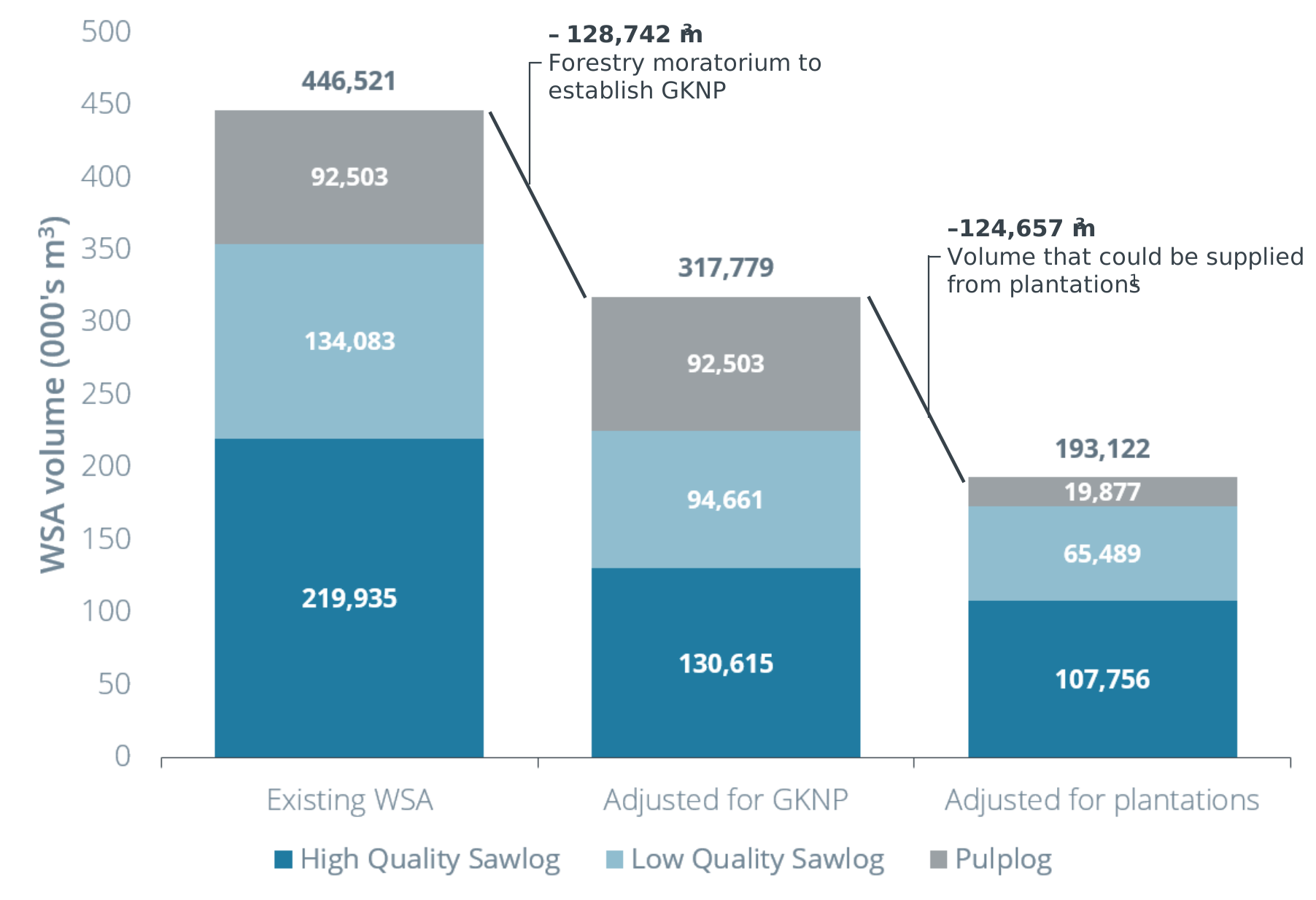
  • Identifying the volumes actually at risk: The headline commitment is around 317,000 m3 a year, but not all of it depends on native forest. Some can be met from plantations, and once the plantation share is removed the exposure is closer to 193,000 m3 (made up of around 108,000m³ of high-quality sawlogs, 65,000m³ of low-quality sawlogs and 20,000m³ of pulp). These are the volumes we carried into the modelling.
  • Benchmarking the cost of a buyout: Actual buyout costs are confidential and negotiated case by case. We used three independent reference points instead: a measure of foregone profit built from the ABARES National Wood Processing Survey and IBISWorld margins, and the compensation rates set by the WA and Victorian Governments in their own transitions away from native forestry. Together these give a range rather than a single figure; buyout costs are highest for high-quality sawlogs where the commercial value of the logs is greatest.
  • Checking the volumes against historical yields: To test whether the plantation split was reasonable, we reviewed FCNSW North Coast sales from FY10 to FY25. Over that period the plantation share of supply rose and the high-quality log share fell from 61% to 44%. The grade mix matters because it directly affects the cost of any buyout.
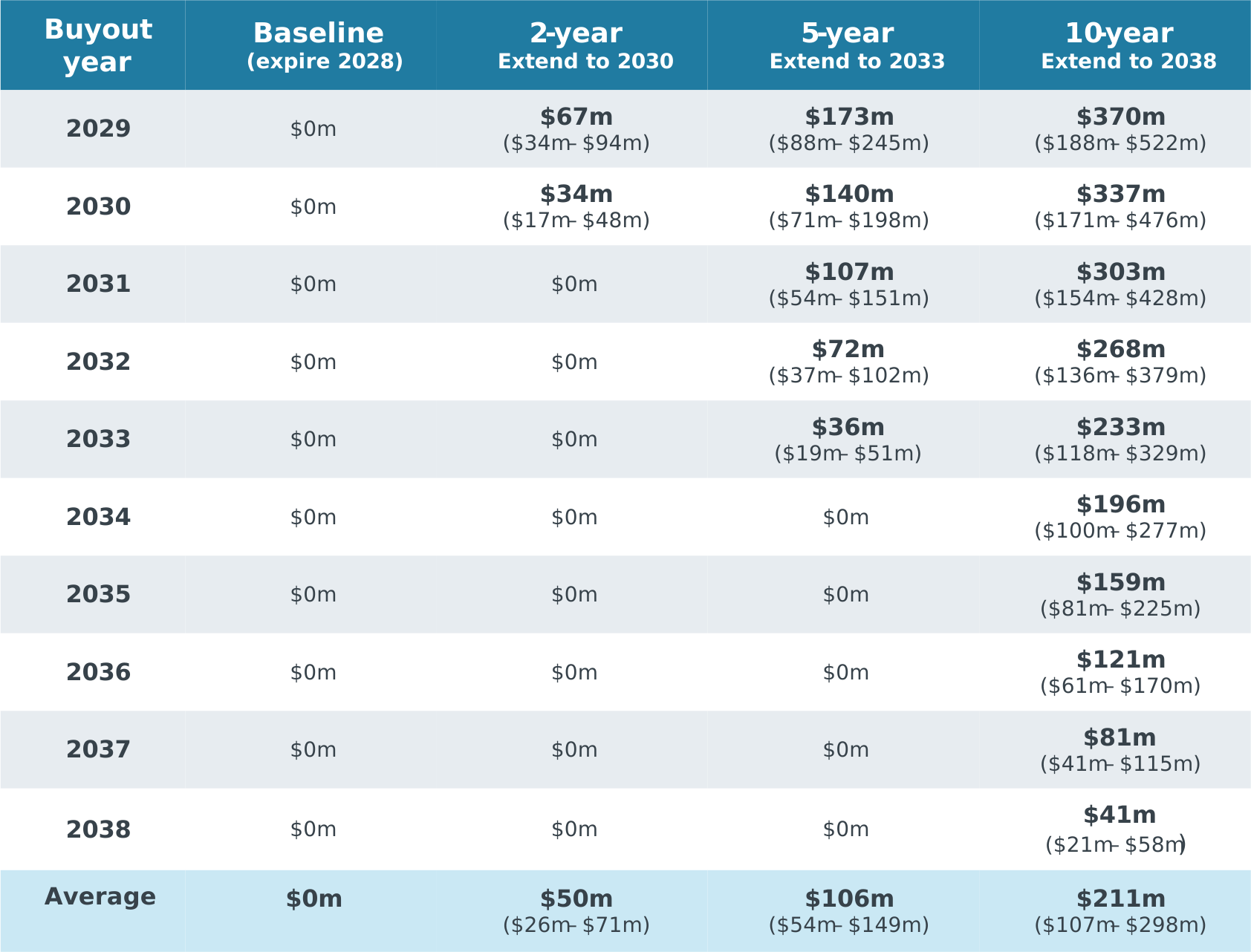
  • Modelling the exposure across scenarios: We then calculated what a buyout could cost under two-, five- and ten-year WSA extension scenarios. For any given year, the exposure is the inflation-adjusted buyout rate per cubic metre multiplied by the committed volume and by the number of years still left on the contract. We reported the results as a range to keep uncertainty visible.

What were the results?

A five-year extension carries average buyout exposure of around $106 million across the term. A ten-year extension roughly doubles that, to around $211 million.

These figures illustrate the potential scale of exposure rather than a prediction. They do not assign a probability to a buyout occurring, and they are not a recommended payment for any individual WSA holder. Actual amounts would turn on business-specific, contractual and negotiation factors. Because the volume of timber available to harvest is falling while WSAs lock in fixed volumes, extending the agreements does not remove that supply uncertainty. It shifts more of the resulting financial risk onto the State.

READ THE SUMMARY REPORT

Related reading

All insights

What can we help you with?

Ask us

Get our latest insights

Sign up