
Australia’s merger control regime changed fundamentally on 1 January 2026. Beyond introducing new notification requirements, the reforms change how parties assess competition issues and engage with the Australian Competition and Consumer Commission (ACCC).
Competition considerations have always been a central part of merger assessments. However, the new merger control regime places a greater emphasis on identifying a suitable pathway for merger assessment. For firms and their legal teams, that makes an early assessment of likely ACCC concerns central to transaction planning. Economics can play a significant role in that assessment by helping parties identify competition risks, test potential theories of harm and develop the evidence needed to support the chosen review pathway.
Having advised clients and their legal teams on a number of transactions under the new regime, our mergers and acquisitions team explains the key changes and their practical implications. We also explore how early economic assessment can help parties navigate the review process and support merger clearance.
What has changed for merger controls?
The most significant change introduced by Australia’s new merger control regime is the move to mandatory notification for certain transactions.
A transaction may need to be notified to the ACCC where it meets one of four notification thresholds:
- Large, merged firm threshold – for transactions involving larger businesses, including where the acquirer has Australian turnover exceeding $200 million.
- Very large acquirer threshold – where the acquirer has Australian turnover exceeding $500 million and the target has Australian turnover exceeding $10 million.
- Creeping or serial acquisition threshold – designed to capture multiple acquisitions that may cumulatively increase market concentration.
- Asset acquisition threshold – applies to certain acquisitions of assets or parts of a business, including by large or very large acquirers.
For transactions that meet these thresholds, parties must consider whether to pursue a notification waiver or proceed through the notification pathway.
Choosing between a notification and a notification waiver under the new merger control
The choice between a waiver and notification depends on the nature of the transaction, the likelihood of competition concerns arising and the evidence available to support the parties’ position.
When is a merger notification likely to be appropriate?
Notification is generally appropriate where a plausible competition question requires further examination.
Entering the notification process does not mean a transaction is anti-competitive. Rather, it means the ACCC may need to undertake further assessment before reaching a conclusion.
For example, the ACCC may wish to:
- assess competitive overlaps between the parties;
- test potential theories of harm;
- consult customers, suppliers or competitors;
- examine market dynamics; or
- consider how competition may evolve over time.
A rule of thumb: a notification is generally the appropriate pathway where a competition question exists and needs to be investigated, even if the transaction ultimately proves unlikely to raise concerns.
When is a notification waiver likely to be appropriate?
A notification waiver is an exemption from the obligation to notify. It may be suitable where a transaction is unlikely to raise competition concerns and the parties can demonstrate this clearly from the outset. The ACCC expects to assess waiver applications largely on the information provided by the parties, without extensive investigation or third-party consultation. If the ACCC cannot reach that conclusion from the application, it may refuse the waiver and require the parties to proceed through the notification process instead.
A rule of thumb: a waiver is most likely to be appropriate where the evidence clearly points towards no competition concerns, even if there is uncertainty about market definition, market shares or concentration levels.
The pathways are not substitutes but have different purposes and evidentiary burdens. Choosing the pathway is therefore a strategic decision about risk, evidence and process — not just timing
Timing and process under the new merger control regime
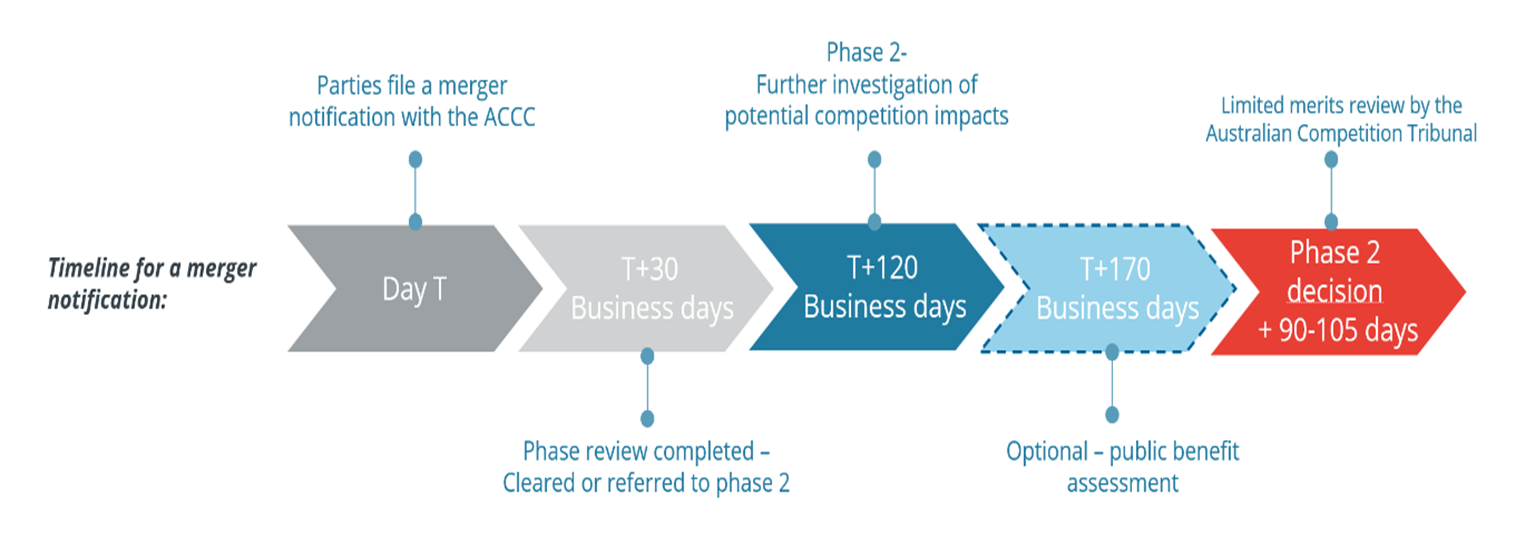
The new merger control regime introduces statutory review periods for merger assessments. The timeline below outlines the main stages of the process and the indicative timeframes that may apply.
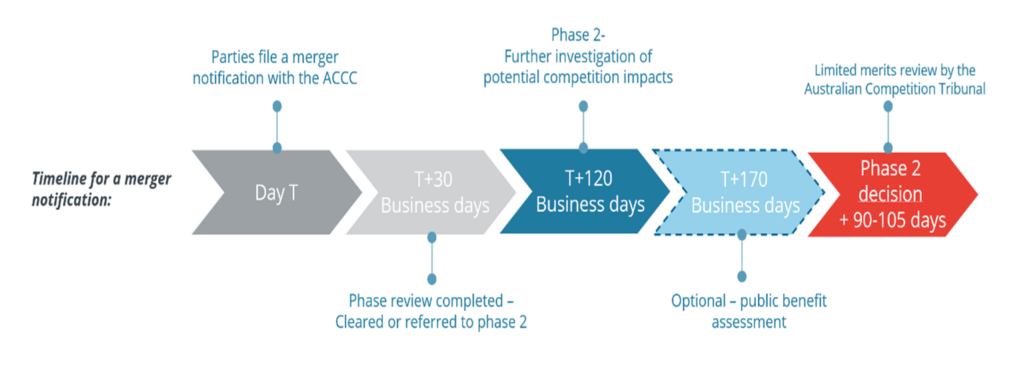
The notification pathway provides for a full ACCC assessment of transactions where a plausible competition question may need to be investigated.
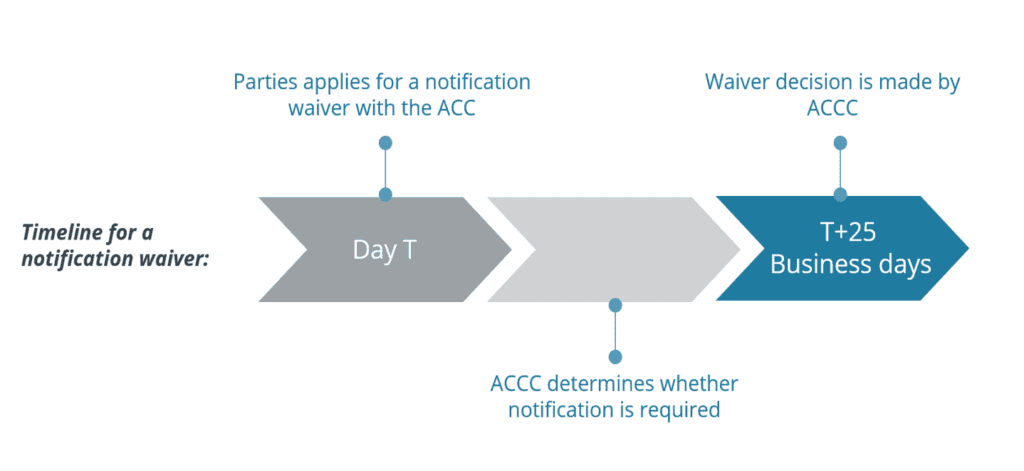
The waiver pathway provides an exemption from notification where the transaction is unlikely to raise competition concerns and can be assessed without further investigation.
The role of economics under the new merger control regime
Choosing between the notification and waiver pathways is not simply a legal or procedural decision. It often requires an assessment of how the ACCC is likely to view the competitive effects of a transaction and the level of evidence needed to support a filing.
Economic analysis can play an important role well before parties’ file. It can help parties understand competitive dynamics, assess the likelihood of ACCC concerns, determine the most appropriate review pathway and develop evidence to support their position.
Waivers for lower-risk transactions
For transactions that appear unlikely to raise competition concerns, economic analysis is often focused on demonstrating why further investigation is unnecessary.
This may include:
- High-level market framing.
- Market share and concentration assessments.
- Identification of key competitors.
- Assessment of any overlaps between the parties.
- Analysis demonstrating why, based on the evidence, no plausible competition concerns arise.
The objective is to provide a clear evidentiary basis for the ACCC to conclude that the transaction is unlikely to substantially lessen competition.
Notifications and ACCC reviews
Where a transaction proceeds through the notification pathway, economic analysis often plays a broader role. The focus shifts from demonstrating that a transaction is clearly benign to assessing and explaining its potential competitive effects.
Economic analysis for notifications may include:
- Defining the relevant markets and competitive landscape.
- Assessing the closeness of competition between the parties.
- Evaluating market shares, concentration levels and barriers to entry.
- Analysing customer, supplier and industry dynamics.
- Assessing the potential competitive effects of the transaction and responding to ACCC concerns.
The objective is to test, debate and provide evidence of competitive effects.
Preparing for ACCC Review under the new merger control
Our economists have advised on waiver applications, notifications and Phase 2 merger matters under the new merger control regime.
We help clients and legal advisers apply the framework described above to the facts of a particular transaction: identifying the competition issues that matter most, selecting the appropriate review pathway and developing the evidence needed to support engagement with the ACCC.
Frequently Asked Questions (FAQs)
How can Frontier Economics help businesses navigate the new merger regime?
Our economists help businesses, and their legal teams, assess competition risks early and determine the most appropriate review pathway. We also develop the economic evidence needed to support ACCC filings.
We have experience analysing market definition, competitive effects, market shares, barriers to entry, counterfactuals and public benefits. Our team can assist legal teams throughout the ACCC review process, including Phase 1 and Phase 2 assessment.
When do businesses undertaking a merger have to notify the ACCC?
If a proposed acquisition meets the relevant notification thresholds, it must be notified to the ACCC before it can proceed. This includes:
- Large, merged firm threshold – for transactions involving larger businesses, including where the acquirer has Australian turnover exceeding $200 million.
- Very large acquirer threshold – where the acquirer has Australian turnover exceeding $500 million and the target has Australian turnover exceeding $10 million.
- Creeping or serial acquisition threshold – designed to capture multiple acquisitions that may cumulatively increase market concentration.
- Asset acquisition threshold – applies to certain acquisitions of assets or parts of a business, including by large or very large acquirers.
Businesses cannot complete a notifiable transaction until they have received ACCC approval or been granted a notification waiver. Early consideration of the thresholds can help avoid unexpected delays to transaction timelines.
What is the difference between a notification and a notification waiver under ACCC’s new merger control regime?
A notification waiver is intended for transactions that are unlikely to raise competition concerns and can be shown to be clearly benign from the outset. A notification is designed for transactions where competition issues may require further examination by the ACCC. The distinction is not simply one of timing. Choosing between a notification and a notification waiver is a strategic decision about risk, evidence and process—not just speed. While both pathways often require similar categories of information, a notification generally involves a more detailed and structured assessment of the transaction’s competitive effects.
What information is required for a merger notification?
A notification is the formal ACCC review process for transactions that meet the notification thresholds. Parties must submit detailed information about the transaction, the businesses involved, the relevant markets and any potential competition issues. The ACCC may also consult with customers, suppliers, competitors and other stakeholders as part of its assessment. Given the greater emphasis on evidence under the new merger control, many businesses undertake economic analysis early to help identify competition issues and support their engagement with the ACCC.
What information is required for a merger notification waiver?
A notification waiver is designed for transactions that are unlikely to raise competition concerns. Parties must provide enough information for the ACCC to conclude that a full notification is not necessary. If the ACCC is not satisfied on the information provided, the parties may need to proceed through the notification process.
Do a merger notification and notification waiver require different information?
Not necessarily. Both pathways often require similar information about the transaction, the businesses involved and the markets in which they operate. The key difference is not usually the type of information provided, but how much analysis is needed. A notification waiver is intended for transactions that are unlikely to raise competition concerns, whereas a notification supports a more detailed ACCC assessment.
What are next steps if the merger meets the notification thresholds?
If a transaction meets the notification thresholds, parties must determine whether a notification waiver or notification is the more appropriate pathway.
Economic analysis can help inform both the choice of pathway and the evidence put before the ACCC during the review process. The transaction cannot be completed until the ACCC grants a waiver or approves the notified acquisition. Where a notification is lodged, the ACCC will conduct a Phase 1 review and, if further investigation is required, may refer the matter to Phase 2. If a notification waiver is granted, the parties do not need to lodge a notification with the ACCC.
Author: Warwick Davis. Industries: Financial Services, Public Policy & Government. Expertise: Competition Economics, Cost-Benefit Analysis & Real Options Analysis, Customer Engagement & Stakeholder Facilitation, Economic Models, Economic Regulation, Financial & Commercial Advisory, Public Policy Advisory.