

Regulation plays a vital role in supporting many of our essential services. It contributes to a well‑functioning society and helps shape outcomes that affect individuals, communities and businesses every day. Because regulatory decisions can have wide‑ranging and long‑lasting consequences, regulatory changes are subject to structured processes that include assessing the impacts of the change, stakeholder and public consultation, and implementation planning.
What is a Regulatory Impact Statement?
A Regulatory Impact Statement (RIS) provides a foundation for developing evidence-based regulation. New, or changed, government regulation is assessed through a RIS which analyses the costs and benefits of options compared to a base case. This includes economic, social and environmental impacts of any proposed regulatory changes.
While RIS are the most common documents used to assess regulatory changes, there are some jurisdiction- or process-specific variants; the common feature is a structured comparison of options against a base case. These include Impact Analysis (IA), Policy Impact Analysis (PIA), Legislative Impact Analysis (LIA) and Better Regulation Statements (BRS). While the focus of the analysis varies — for example, policy or legislative changes rather than regulatory changes — the scope of the document is broadly the same. The Australian Government Office of Impact Analysis has a new Impact Analysis Framework which commences from 1 July 2026. While this framework introduces two tiers of document — a dashboard IA and a detailed IA — the underlying scope still aligns with other RIS guidance.
The 7 questions for forming a RIS
When a RIS is developed, there are seven key questions which must be answered. These are outlined in the Australian Government Guide to Policy Impact Analysis (which was formally presented as the Australian Government Guide to Regulatory Impact Analysis) and echoed in other guidance. These questions are designed to ensure accountability and transparency in regulation development and implementation.
The seven questions comprise:
- What is the problem you are trying to solve?
- Is government intervention needed?
- What policy options are you considering?
- What is the likely net benefit of each option?
- Who did you consult and how did you incorporate their feedback?
- What is the best option from those you have considered?
- How will you implement and evaluate your chosen option?
In essence, these questions seek to ensure that policy makers are clear on the problem that a regulatory change is seeking to address, that a range of intervention options have been considered, that there is a clear rationale for selecting a preferred option and that thought has been given as to how to deliver the preferred option. The transparency around these key considerations is intended to help prevent the implementation of poorly justified regulatory changes.
Common pitfalls in the RIS development process
Failing to establish need
Having a clear picture of the market or regulatory failure which underpins the RIS helps to determine appropriate interventions. Understanding the rationale for regulation is a critical starting point which provides focus for the options that follow. When a need is not clearly established, there is a risk of reaching a regulatory solution which doesn’t address a clear problem.
IN PRACTICE
For example, Safe Work Australia’s Regulation Impact Statement for prohibition on the use of engineered stone focuses on problems which include that Australian workers are developing silicosis as a result of working with engineered stone and there has been insufficient compliance with the model WHS laws for the level of risk. These are undoubtedly important issues, but a RIS should be seeking the underlying cause, such as gaps in the health and safety regulatory framework – perhaps lack of awareness of regulations in this sub-sector or lack of enforcement against existing requirements.
Narrow or incomplete options
Similarly, not fully defining the alternative options, or considering an insufficient range of options, can lead to difficulties in obtaining approval for a RIS. Whilst it can be complex, a robust set of options is essential for meaningful impact analysis. This requires defining both temporal and scope elements:
- Who does the regulation apply to?
- Are there any exemptions?
- Will the regulation be mandatory or opt-in?
- Are there any non-regulatory tools or options?
- When will the option be introduced?
- Will there be a transition period?
All these factors impact how an option would function and hence, the impacts that it would have.
IN PRACTICE
Again, the Safe Work Australia’s Regulation Impact Statement for prohibition on the use of engineered stone is an instructive example. It considered three options.
Option 1: Prohibition on the use of all engineered stone
Option 2: Prohibition on the use of engineered stone containing 40% or more crystalline silica
Option 3: As for option 2, with an accompanying licensing scheme for persons conducting a business or undertaking working with engineered stone containing less than 40% crystalline silica.
However, those options were prohibition on the use of all engineered stone and two variants with different thresholds for the ban. The issue here is an insufficient range of options being assessed – this RIS would have been well suited to considering non-regulatory options (e.g. different behavioural change campaigns or information campaign for alternative products) together with options for reforms to the existing health and safety regulatory framework.
How economic analysis plays a role in a RIS
A RIS requires options assessment. Guidance makes clear that economic analysis – in the form of cost-benefit analysis including sensitivity analysis and distributional analysis – is the best practice approach though other assessments methods, such as multi-criteria analysis can also be accepted.
Our experience is that there is clear value in economic analysis of reform options even when significant data gaps exist. It is often the case that there isn’t robust evidence on the precise extent to which a reform would drive benefits. While this means that the precise net benefit cannot be estimated, it does not mean that economic analysis can’t inform decision making. Economic logic can often be used to deduce which is most beneficial of the options assessed. Alternately, a breakeven analysis can be a useful tool to understand the level of benefits required in order to understand when a reform would be net beneficial.
IN PRACTICE
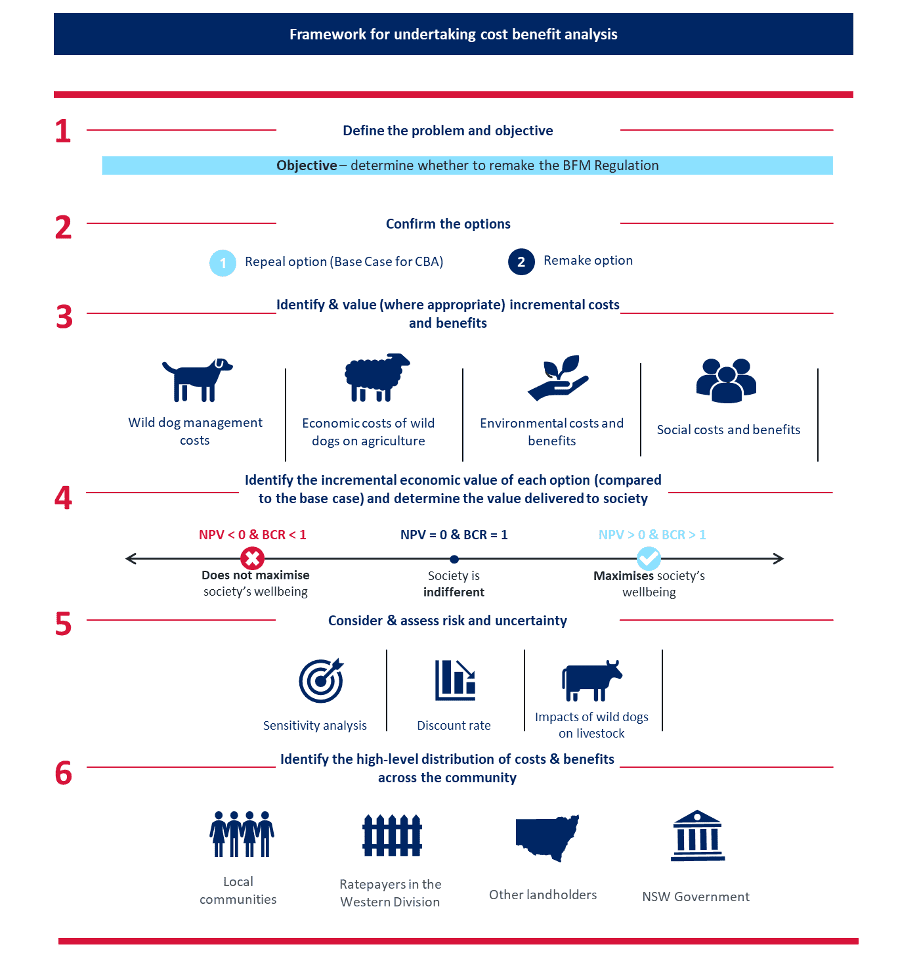
In this project for regulatory changes to The Border Fence Maintenance Regulation, which provides for the maintenance of a 600km wild dog border fence along parts of the South Australian and Queensland borders of New South Wales, the complex process included many economic techniques to identify the costs and benefits to the community from each reform option.
We were tasked with a cost benefit analysis that required a thorough review of options and included identifying and valuing hard-to-value/measure costs and benefits. Using a range of analysis including sensitivity analysis, the RIS considered the impacts across a range of stakeholders.
Stakeholder or public consultation
Transparency is a key feature of a RIS – both inclusion of key stakeholders in developing a RIS, and the publication of the RIS. An important feature of a RIS is understanding the perspective of the individual people, community groups and businesses affected by proposed regulatory options. Transparency does not mean making decisions by consensus. Rather, it means using stakeholders to inform evidence-based decision making.
Our experience has shown that we should:
- Avoid conducting consultation late in the process, once key decisions have effectively been made. This is because consultation is particularly useful for identifying options and impacts.
- Seek evidence from stakeholders to inform options assessment, as they often have the best data on specific elements of the regulatory reform being considered.
- Ensure transparency in how submissions are considered to maintain credibility.
Effective consultation should inform the development of options, test assumptions, and surface implementation challenges early.
Key takeaway: Developing a thorough RIS is a valuable discipline
Done well, a RIS makes an important contribution to the development of good regulatory frameworks. They bring together economic rigour, stakeholder insights and practical considerations to identify the best way forward. More than that they help stop poorly considered regulation that may otherwise create unnecessary red tape.
Economic analysis checklist:
- Define base case/counterfactual and reform options
- Quantify costs/benefits where feasible
- Use sensitivity analysis for key uncertainties
- Consider distributional impacts
- Use break-even analysis when benefits can’t be quantified
Further reading
To learn more, here are some reference documents you should read:
Authors: Ben Mason, Anna Wilson and Ambrose Bub. Industries: Energy & Renewables, Financial Services, Public Policy & Government, Retail & Consumer, Telcos & Digital Media, Urban & Rural Water, Urban Design & Development. Expertise: Behavioural Economics, Benchmarking & Productivity, Biodiversity & Environmental Economics, Cost-Benefit Analysis & Real Options Analysis, Customer Engagement & Stakeholder Facilitation, Economic Regulation, Public Policy Advisory.