The Murray-Darling Basin Plan (Basin Plan) Review has major implications for irrigation-dependent communities and for how environmental water is managed across the Basin.
As part of their submission to the Basin Plan Review, we were asked by Murray River Council (MRGC) and Greater Shepparton City Council (GSCC) to provide independent technical economic analysis to inform their submissions.
Our analysis finds that additional water recovery alone is unlikely to materially improve environmental outcomes. Instead, the stronger opportunity may lie in improving how existing environmental water is managed and delivered, while recognising the significant socio-economic impacts that further buybacks can have on regional communities.
Managing water in the Murray-Darling Basin
The Murray-Darling Basin (MDB) is Australia’s largest and most complex river system. The MDB is Australia’s predominant agricultural region, producing one third of Australia’s food supply and over a third of Australia’s total gross value of agricultural production. The region also contains over 30,000 wetlands, including 16 Ramsar-listed wetlands. There are also at least 10,000 known Aboriginal sites in the MDB, indicating the deep physical, economic, and spiritual dependence of Aboriginal people on its rivers, creeks, lakes, and wetlands.
The Commonwealth and Basin states work together to manage the water in the Basin under the framework established by the Water Act 2007. This Act seeks to “promote the use and management of the Basin water resources in a way that optimises the economic, social and environmental outcomes” including:
- To ensure the return to environmentally sustainable levels of extraction for water resources that are overallocated or overused
- To protect, restore and provide for the ecological value an ecosystem services of the MDB
- Subject to the above, to maximise the net economic returns to the Australian community from the use and management of Basin water resources.
A key instrument under the Act is the Basin Plan overseen by the Murray-Darling Basin Authority (MDBA), which seeks to improve environmental outcomes throughout the Basin — while also optimising social and economic outcomes from water use. The MDBA is currently undertaking a review of the Basin Plan. Given the far-reaching potential impacts of the Basin Plan, it’s unsurprising that the MDBA has received more than 2,400 submissions to its Basin Plan Review Discussion Paper.
View the MRGC and GRCC’s submission and our independent technical economic analysis here:
Our analysis highlights that measuring Basin Plan impacts at the Basin scale, and across both irrigation and dryland agriculture, can mask what is happening in irrigation-dependent regions. In these areas, the impact can be several multiples of the southern Basin average, with compounding effects of repeated shocks on business confidence, workforce retention and investment in these communities.
Given the significant socio-economic impacts of past and potential future buybacks, it is critical that water for the environment actually achieves environmental benefits in the most efficient and effective way. However, our analysis found that:
- Risks to Basin Plan environmental outcomes are unlikely to be solved by simply ‘adding more water’ (according to the MDBA’s own modelling).
- Rather, improving how the large existing holdings of environmental water are managed and delivered is required.
We elaborate on these key findings below.
Why more water recovery may not lead to better environmental outcomes
A key goal of environmental water management is to maximise environmental outcomes from the water already recovered.
As part of its review, the MDBA undertook initial Sustainable Diversion Limit (SDL) Assessments (the amount of water that can be taken in each of the 29 surface water areas and 80 groundwater areas across the MDB (known as ‘Resource Units’) while aiming to keep the system environmentally sustainable). This was to investigate whether the existing SDL for a specific Resource Unit continues to reflect an ‘Environmentally Sustainable Level of Take’ and helps achieve the Basin Plan’s environmental goals under current, fully implemented, and future climate conditions.
The initial assessments compare the environmental outcomes between current SDL settings and full implementation of the Basin Plan (including additional water recovery) under two scenarios or ‘lines of enquiry’:
- Line of Enquiry 1 (LoE1) — current Basin Plan implementation — current level of water recovery.
- Line of Enquiry 2 (LoE2) — full Basin Plan implementation — recovery of the full 450GL Water Amendment (Restoring Our Rivers) Act 2023 plus the expected 300GL Sustainable Diversion Limit Adjustment Limit (SDLAM), which allows some environmental outcomes to be achieved through measures other than recovering more water, shortfall (i.e. an additional 450GL+300GL).
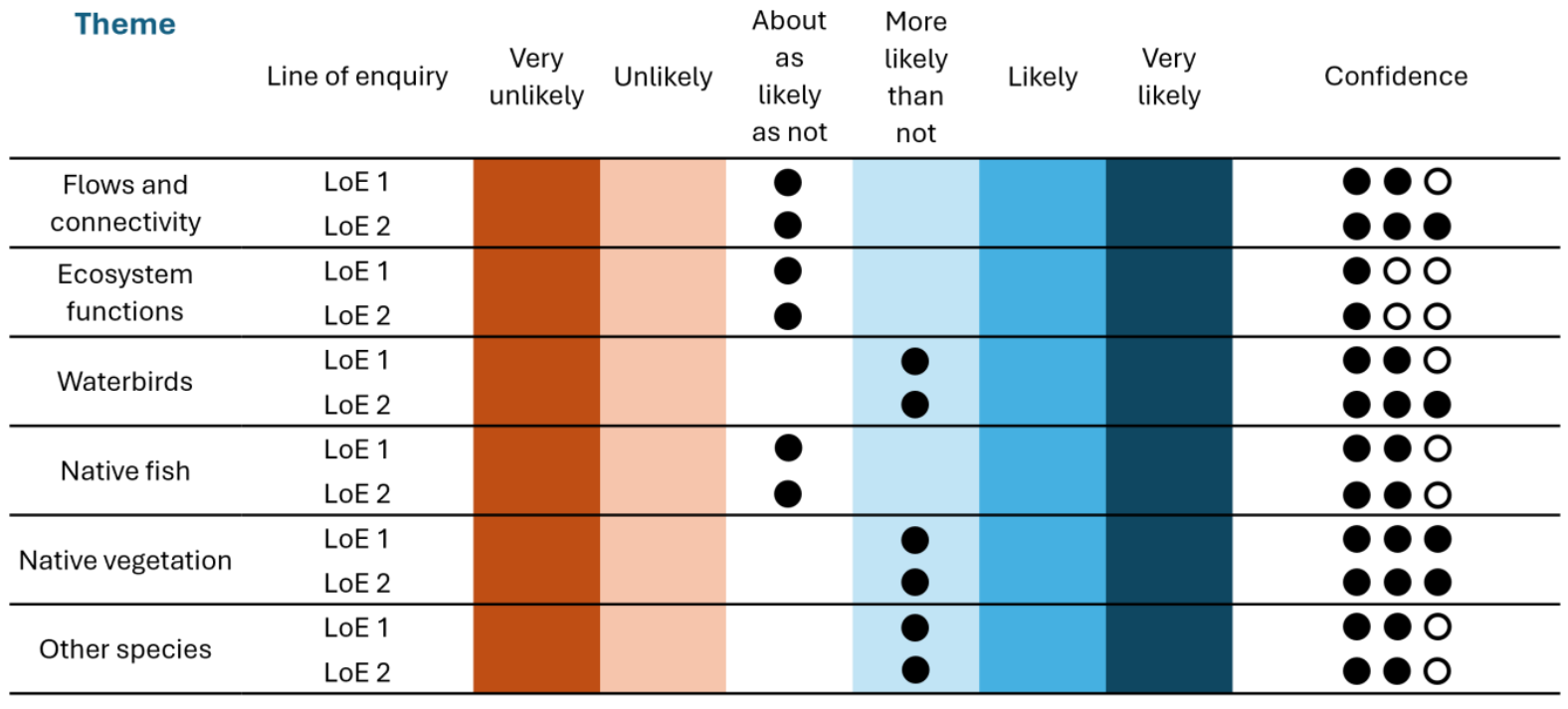
Overall, for SDL Resource Units of the Murray (in each of the States) and in Victorian rivers, the MDBA’s own SDL assessments showed no meaningful change in the likelihood of achieving outcomes between the two scenarios. As shown in the figure below, additional water from recovery of 300GL SDLAM shortfall and the full 450GL under the Water Amendment does not increase the likelihood of supporting the objectives across ecological themes for the Victorian Murray SDL Resource Unit. The key take-away from this is that environmental outcomes may benefit little from additional buybacks alone.
The likelihood that the pattern and volume of flow will support the objectives for each ecological theme in the Victorian Murray SDL resource unit
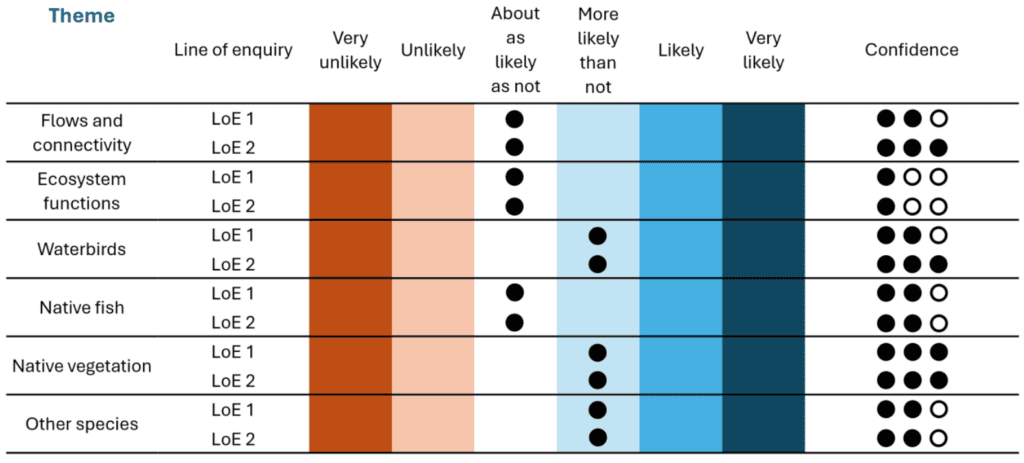
Source: MDBA 2026, Victoria Murray (SS02) SDL Assessment
How environmental water can be managed more effectively
An important conclusion from this analysis is that rather than simply recovering more water, achieving stronger ecological outcomes requires ensuring that agencies that manage water for environmental purposes are as efficient as irrigators in managing water.
Our analysis finds that there is considerable scope to improve environmental outcomes from better management of the large environmental water portfolio accumulated through water recovery to date.
These options include:
- Relaxing rules for water trading by the Commonwealth Environmental Water Holder (CEWH): During the period when environmental water holdings were being built up, the CEWH, the Australian Government body responsible for managing environmental water holdings, has been bound by the environmental purpose test in the Water Act 2007. This test means the CEWH may sell water only if the water is not required in the current water year to meet the Environmental Watering Plan that has been developed to optimise the use of water to achieve environmental objectives. The test also means that the CEWH cannot carry over water for use in future years which means that unused water will be forfeited or reduced. Given the large and mature portfolio of water entitlements held by the CEWH, and the sophistication of other aspects of environmental water management, the limits on water trading by the CEWH under the Water Act may no longer be appropriate — and may be constraining the optimal management of risks to environmental outcomes.
- Relaxing river constraints: Relaxing river constraints such as physical or operational limits that prevent water from moving across floodplains and wetlands in a more natural way in the MDB is essential for enabling higher environmental flows. It allows water to flow over banks onto floodplains and into wetlands that have become disconnected from the main river channels. By increasing the flexibility to deliver water from storage dams, these initiatives re-establish more natural seasonal flow regimes, which are critical for restoring ecosystem health in a drier climate.
- Infrastructure works: Works have been shown to be effective in the management of risks to environmental outcomes. There are opportunities for further such investments, such as Victorian Murray Floodplain Restoration Project sites that were proposed under SDLAM but are yet to proceed.
- Arrangements for bulk environmental water delivery: A key challenge in achieving environmental outcomes is using environmental water entitlements within the delivery/property arrangements that were originally designed for irrigators and other consumptive water users. Mechanisms have been created under the Basin Plan to facilitate effective environmental water delivery (i.e. Pre-requisite Policy Measures), and the Southern Connected Basin Environmental Watering Committee supports the coordination of the delivery of water for the environment.
Although the processes and communication around environmental water management (namely between environmental water managers and river operators) have improved greatly over time, there appears to be scope to further enhance the management of risks to environmental outcomes. For example, the Objectives & Outcomes for River Operations (O&O), which guides river operators, sets objectives for the MDBA involving balancing multiple requirements — including the objective “to contribute to the protection and, where possible, restoration of priority environmental assets and ecosystem functions within the system”. Currently, there is limited guidance on how the MDBA should make decisions about trade-offs. There may be ways in which Basin Officials Committee (which produce the O&Os) could further direct river operators to manage environmental water delivery, especially in shortfall events or times of limited river capacity. This could further strengthen environmental planning for water delivery.
Another key finding of our report is that the specific objectives of environmental water management also need to be realistic. For example, Schedule 5 of the Basin Plan (Enhanced environmental outcomes) requires that the mouth of the River Murray is open without the need for dredging in at least 95% of years, with flows every year through the Murray Mouth Barrages. However, presentations by the MDBA suggest that Murray Mouth and end-of-system objectives may not be realistically achievable and are being re-thought. This example also highlights that many of the environmental challenges in the MDB arise from the regulation of water flows (and associated structures), rather than solely from the extraction of water for consumptive uses (as is being addressed via water recovery).
In our view, water recovery to pursue objectives that may not be realistic does not represent good policy. Rather, environmental water managers should be given achievable objectives as well as the appropriate tools to best realise them in practice.
Authors: Dave Appels, Mike Woolston and Hugh McCormack. Industries: Climate Change & Sustainability, Natural Resources & Agriculture, Urban & Rural Water. Expertise: Biodiversity & Environmental Economics, Environmental, Social & Governance - ESG.